Curatorial Review – Despina Tunberg (World Wide Art Books®)


Bikkel Artist: Light, Grid, and the Distance Between Two Worlds
Curatorial Review by Despina Tunberg
Bikkel Artist was born on Curaçao in 1948, and that origin is not incidental to her practice — it is the practice's deepest source. The light, water, and color of the Caribbean island run through everything she makes, whether in glass or on canvas, and her decades of living and working in the Netherlands have not displaced that origin so much as placed it in productive tension with the distance that separates her from it. The longing, the layering, the grids that appear throughout her work as structures that simultaneously hold and release — all of these grow from the particular experience of a life lived between two worlds, two climates, two ways of understanding what it means to belong to a place.
Bikkel graduated with exceptional distinction from the Willem de Kooning Academy in Rotterdam in 2002, a formal recognition that arrived after years of self-directed development, and the combination — rigorous training, autonomous instinct — is legible in the work. She does not begin from style or from a predetermined palette. She begins, as she describes it, from an idea that moves her: a memory, an event, a feeling, an image that presents itself. The work follows the impulse rather than the plan, and the results carry the authority of that directness. She works quickly and intensely, sometimes completing a work in a single day when the impulse is clear enough to sustain the pace from start to finish.
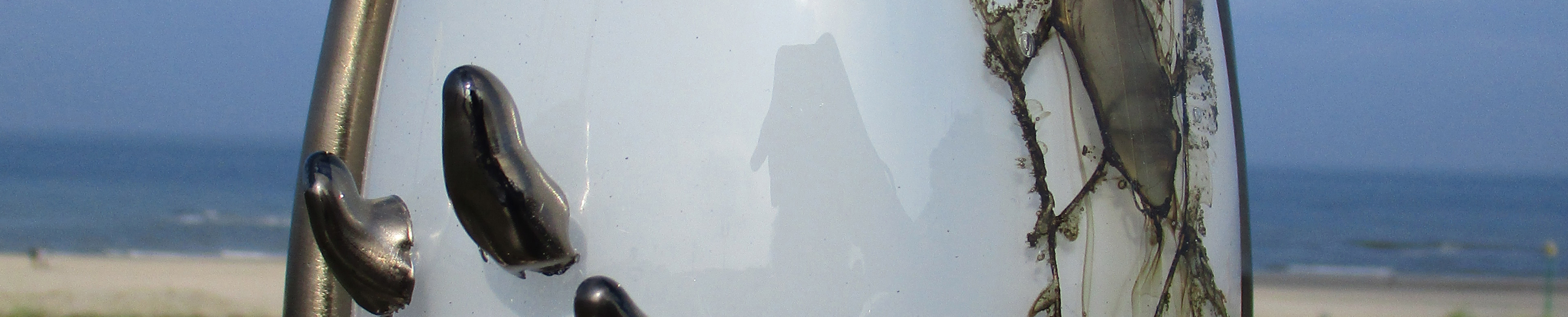
Glass is her primary material, and the choice is anything but arbitrary. Glass carries water. It is transparency made solid, light made holdable, movement frozen into form. In Bikkel's hands it is also the material of Curaçao itself — the Caribbean light passing through glass behaves the way Caribbean light passes through water, and the colors she brings to her glass works — the warm blues, the luminous greens, the deep turquoise — are the colors of the sea she grew up beside. Metal enters the glass works as structure and as counterpoint: where glass stands for water, flow, and translucency, metal stands for pain, for scarring, for the kind of strength that has been tested and survived the test. The pairing is not decorative; it is a statement about what endures and what it costs to endure.
The grid is among the most recurring and most charged elements in Bikkel's oeuvre. In her glass works it appears as actual metal structure — the armature that holds the glass in place, that gives it both support and limitation. In her paintings it appears as something more personal and more layered: a reclaimed fishing net, applied to the canvas and then worked over with spray paint, so that the grid becomes simultaneously a found object, a memory of labor and water, and a visual filter through which the painted image is seen. The grid, Bikkel has said, speaks of migration, of longing, of permeability and distance. It is the form that holds you and the form that separates you; the structure that keeps things together and the structure through which things escape or disappear. For an artist whose life has moved between Curaçao and the Netherlands, it is an almost inevitable formal choice — and yet it feels earned rather than imposed, discovered rather than deployed.
Bikkel organizes her oeuvre into three cycles: the Open Line, the Dense Line, and the Free Line. These are not merely organizational categories but descriptions of emotional and formal states. The Open Line works carry the character of beginning and of breath — forms that reach outward, surfaces that allow light to pass through or around them. The Dense Line works are more concentrated, more interior, built from accumulation and compression. The Free Line represents the fullest expression of autonomous gesture, the work that most directly follows the impulse without negotiation. Taken together, the three cycles map a complete emotional range, and the artist's ability to move across them — rather than settling into one register — speaks to a practice that remains genuinely alive to its own possibilities.
The series titles across the gallery — Connection, Born from My Inside, Nature, and the glass fish works — confirm the consistency of her preoccupations. Connection is perhaps the most explicit statement of what binds all the work together: the question of how things and people relate, how relationships are formed and sustained across distance, how the lines between individuals — whether in glass or on canvas — can be traced. Born from My Inside is the autobiographical strand made overt: these are works that declare their origin in the artist's interior life without apology or mediation. The Nature series opens the practice outward into the observed world, while the glass fish carry the Curaçaoan sea life into threedimensional form, the transparency of the material perfectly suited to creatures that live within transparency.
The exhibition record confirms a practice of genuine institutional reach. Bikkel's work is held in the collections of Museum Voorlinden — one of the Netherlands' most significant contemporary art institutions — and The Curaçao Museum, a placement that closes the biographical circle between origin and recognition. In 2026 she presented work at Museum Maassluis, the institution adjacent to her studio in that city, and in the same year published her first museum catalog, in which her glass works and paintings are brought together as a single artistic lifeline. The catalog is itself a statement: that the two sides of the practice — the pictorial and the sculptural, the painted and the blown and constructed — are not parallel careers but one continuous inquiry, conducted in different materials.
At the BAM — the Bikkel Artist Museum, her atelier in Maassluis — she works daily on both her core collection and new series. The decision to name her studio a museum is not grandiosity but precision: it signals that the work is being built with the permanence of a collection in mind, that each piece is understood as part of an accumulating record rather than a series of discrete commercial transactions. It is entirely consistent with an artist who describes her body of work as a timeline of her life — a document as much as a practice, the record of what moved her and when and how she responded to it.
From a Collector’s Eye
Bikkel Artist offers the collector something that has become increasingly rare: a dualmedium practice of genuine depth, in which glass and painting are not separate pursuits but two expressions of the same sustained inquiry. The glass works are particularly significant for a collection — they carry the full weight of her Curaçaoan identity in material form, and the relationship between the glass, the metal armature, and the light that passes through them changes with the light of the space they inhabit, making them living presences in a room rather than static objects. The paintings, with their layered grids and spray-worked surfaces, repay close attention and reward re-encounter over time: the grid structure gives the eye a framework to enter by, while the painted forms and colors beneath and through it hold depth that successive viewings continue to reveal. Museum Voorlinden and The Curaçao Museum have already made their assessment. For the private collector, the opportunity is to acquire a voice of established institutional standing while the practice remains actively in development — the 2026 museum catalog marking not a conclusion but a new phase of a long and serious career.
Despina Tunberg Curator and Author
https://www.amazon.com/stores/author/B0HDVLKLBS
________________________________________________________________________
5533 Cathedral Oaks Rd, Santa Barbara, CA 93111, U.S.A., Tel / fax +1 805 770 5136 Email: info@wwab.us Website: www.wwab.us